From the moment you prepare for your trip to the time you return to the dock, this comprehensive boat safety guide will help you protect yourself, your passengers, and your vessel. Safe and responsible boating includes completing pre-launch checks, carrying required safety equipment, and following the rules of the water.
Give yourself additional peace of mind by preparing for unexpected mechanical or electrical problems with an extended boat warranty that covers major components essential to your safety. That way, you can focus on enjoying your time on the water without worrying about costly repairs down the line.
In This Guide:
Part 1: The Pre-Departure Checklist
Your first line of defense against issues on the water is a pre-departure checklist. Taking the time to inspect your boat before heading out can prevent accidents, mechanical or engine failures, stranding, and boat damage. If you notice problems, do not attempt to ride them out. Addressing small problems early can prevent major repairs later.
Engine and Fluids
Before you leave the dock, check your oil, coolant, and other essential fluid levels. Inspect the engine compartment to ensure there are no leaks, and check your hoses for holes and hose connections. If necessary, change the oil filter, spark plugs, or water filter. Drain any water from the engine compartment, and firmly replace the drainage plug.
Fuel
Confirm the fuel level is sufficient for the trip with some reserve, and bring spare fuel. As a general rule, plan on 1/3 of fuel to go out, 1/3 to return, and 1/3 as a reserve. Check the tank, fuel lines, and carburetor for fuel leaks before departing.
Electrical Systems
Test all navigational and interior lights, as well as safety components that rely on your electrical system, such as your horn and bilge pump. Do not depart until you have addressed any electrical issues. Continuing to operate your boat could lead to other component failure or an expensive electrical system replacement.
Battery
Check that your battery is fully charged, and the connections are clean and secure. Loss of battery power can leave you stranded on the water or unable to take action to avoid a collision. Replace your battery every three to five years based on the manufacturer's or a marine specialist's recommendations.
Deck and Hull
Complete a final visual check of the drain plug and lines, and look for obvious hull damage to complete your boat safety checklist. Test the steering and throttle to make sure they are performing properly. Lastly, double-check that all required safety equipment is on board, accessible, and in working order for every passenger.
Part 2: Mandatory Boat Safety Equipment
Boating safety equipment requirements vary by boat length and location. U.S. Coast Guard (or USCG) safety requirements apply in all navigable waters, such as oceans, bays, and large lakes and rivers that cross state lines. State boating regulations also apply, including on smaller, landlocked waterways, and in many cases, they are even stricter. Always follow whichever rules are most rigorous to ensure compliance and safety.
The following are USCG safety requirements and minimum equipment standards, which vary based on the size of your boat. For a complete listing of standards, please study the USCG Federal Requirements for Recreational Boats to make sure you meet all requirements and keep your boating license in good standing.
Personal Flotation Devices
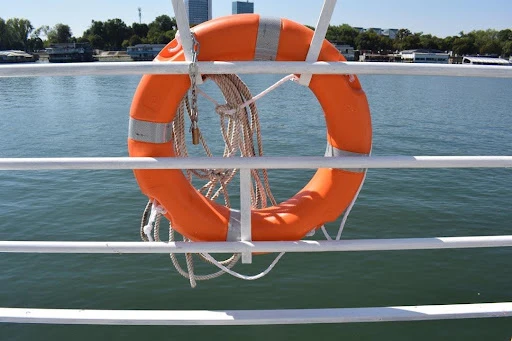
You must have a personal flotation device, or PFD, that properly fits each person on your boat, including children. Boats that are 16 feet or longer must also carry at least one throwable flotation device, such as a life ring or cushion. Your PFDs must be in good repair, within easy reach, and not buried under other equipment.
Always check that your PFDs are USCG-approved, and that the indicated performance level matches your activities and location. For example, a PFD with a 50 or 70 rating is okay near shore in calm waters, but you need 100 or 150-rated PFDs for rougher, offshore conditions.
Fire Extinguishers
If your boat was manufactured between 1953 and 2017, you can carry unexpired B-I, B-II, 5-B, or 20-B rated extinguishers. When you replace them, only 5-B or 20-B models are acceptable. Boats built in 2018 or later must have exclusively 5-B or 20-B rated extinguishers.
Place your extinguishers in easily accessible areas, especially near high-risk zones such as the engine compartment or galley. The number of extinguishers required depends on your boat's length and whether it has a fixed fire suppression system. Please refer to the USCG fire extinguisher requirements for details. Beyond meeting requirements, do what you feel is safest, including carrying a spare.
Visual Distress Signals
The USCG requires you to carry visual distress signals, or VDSs, in certain areas, but it's best practice to carry them at all times. Boats less than 16 feet in length don't have to carry day signals, but must have them when traveling from sunset to sunrise.
VDSs can be pyrotechnic devices such as flares or smoke signals, or non-pyrotechnic devices such as orange distress flags and electronic VDSs. They must be in good working order and unexpired. You can use a combination of devices to meet regulations, such as having three hand-held red flares, or one hand-held red flare and two parachute flares.
Sound-Producing Devices
You must have a horn, whistle, siren, or bell so you can produce a signal in situations including crossing, overtaking, or intersecting with another boat. You must also use a sound-producing device when there is reduced visibility or while you are anchored to help avoid collisions.
Other Equipment
Essential boating safety equipment isn't only what is legally required, but what keeps you safe. Other items are not always mandatory, but boating safety tips aren't complete without suggestions such as:
- First aid kit
- Anchor
- Tool kit
- Sun protection
- Extra non-perishable food and water
- Spare propeller
- Bad weather apparel
Part 3: Rules of the Water and Safe Operation
Staying alert and following boating rules of the road avoids harming yourself, others, or your vessel. Take the time to learn basic emergency procedures so you can react in case of an accident.
Maintaining a Lookout
Situational awareness is essential when you are on the water. Constantly look for other boats and swimmers and keep an eye on weather conditions. Remember that smaller crafts, especially non-motorized ones, can be challenging to spot in the water, as can people.
If you are unsure about any object in the water, reduce your speed well before you reach it. If you spot a storm forming, return to shore immediately. Don't wait it out.
Right-of-Way
In boating terms, a stand-on vessel is one with the right of way, while the give-way vessel must adjust its course to avoid a collision. Some rules regarding right of way on the water include:
- Non-motorized vessels, such as sailboats, have the right of way over motorized vessels.
- When crossing paths, a vessel on your starboard side has the right of way. You have the right of way over a boat on your port side.
- When you pass another boat, you are the give-way vessel.
- When two vessels approach head-on, each pilot turns to their starboard side.
- In a channel, both boats move to the right, and the boat with the bigger draft has the right of way.
Speed and Alcohol
Always maintain a safe speed and distance from other boats and people. This includes reducing your speed when you may be producing wakes that topple other vessels. It's okay to speed up when passing, but remember that you are the give-way vessel. The other pilot has no duty to move over for you.
There are strict federal and state laws against boating under the influence. Violating those rules can lead to accidents due to impaired judgment and reaction time, and could result in jail time, fines, and losing your boating license.
Emergency Procedures
Emergencies sometimes happen despite proper preparation, so learn boating emergency preparedness and response. For example, if someone goes overboard, shout "Overboard!" to alert others. Reduce your speed and turn upwind if possible to slow the boat as you are approaching the person in the water. Turn off your engine before throwing them a life ring.
Protect Yourself and Your Boat
Knowing what to check before boating, carrying mandatory boat safety equipment, and knowing the rules of the water keep you safe and protect your boat against damage. Failing to maintain your boat or skipping safety steps can lead to dangerous conditions and the potential for expensive repairs.
Following this boat safety guide can reduce your risks, but you can do more. Build a safety net by contacting America's Boat Warranty. We provide extended boat warranties that give you financial protection and peace of mind against unexpected mechanical and electrical breakdowns that could compromise safety on the water.
Don't let expensive repairs and an expired warranty keep you off the water. We offer several extended warranty plan levels so you can find one that suits your budget and your boat.
View Warranty Plans